
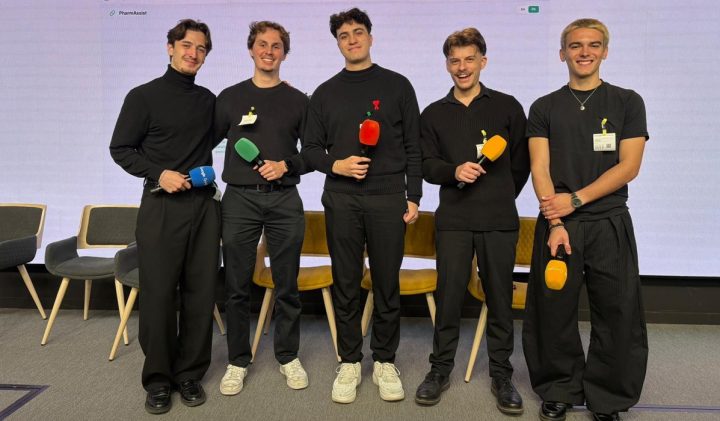
Students from 20 French institutions took part in the GCPU Agentic AI Hackathon, an initiative dedicated to the practical uses of autonomous agents. The ESILV team, with its Pixia project, was among the 11 finalists who presented their solutions at Google’s premises.
This edition, organised by Delphin B., Executive Leader in Cloud Partner Strategy & Ecosystem Development at Google, highlighted the ability of agent-based solutions to address a variety of issues, while promoting collaboration between technical and business profiles.
Understanding the role of AI agents in real-world use cases
The GCPU Agentic AI Hackathon took place over a month and brought together 35 teams supported by academic coaches and Google Cloud mentors, as well as several experts from partner organisations: Thomas Laporte (SFEIR), Florent Legras (Prodiges), Randall Ussery, Hugo Colusso (Tech Invaders) and the Devoteam | Google Cloud Partner teams.
The goal: to design systems capable of planning, reasoning and executing complex tasks autonomously.
Participants chose one area of impact from five key domains: health, education, energy & environment, data intelligence and disability.
Pixia: a generative learning platform developed by a team of ESILV finalists
The Pixia project, developed by Tom Delahaye, Gabriel Carlotti, Pierre Briand, Kentin Guillemot and Alexandre Laroudie, responds to the need for educational tools capable of adapting content, exercises and learning paths to the specific needs of each user.
Pixia is based on a multi-agent system capable of generating illustrated courses, offering personalised exercises and structuring learning paths for technical fields such as artificial intelligence and cybersecurity. An intelligent co-pilot enriches the experience with a contextual understanding of the questions and needs expressed.
From a technological standpoint, the platform combines a Python backend, a React frontend, a Cloud SQL database, deployment on Cloud Run, and an architecture supported by Google ADK.
Pixia was presented in the final round during a session bringing together the 11 selected teams.
Other ESILV projects entered in the competition
Two other ESILV teams took part in the hackathon, with proposals focused on personalised nutrition and health.
MyPlate: a personalised nutritional analysis approach
The team, made up of Natalia Gérard, Valentin Templé, Valentin Rech, Paul Ranc and Héloïse Roméo, presented MyPlate, an application that automatically analyses a meal using Vision AI and offers recommendations tailored to the user’s profile. The project uses communication agents, a Python backend, a React frontend and deployment on Google Cloud Platform.
Health AI prototype: diagnostic assistance via a multi-agent architecture
A third team, composed of Yannis Brik, Sami Chellia, Mouslimah D., Ines Difri and Harrisson Tevoedjre, developed a prototype based on LangGraph and Vertex AI Embeddings to detect medical risks from structured data. The architecture mobilises several specialised agents, including a GraphDetect Agent and an Answer Agent based on Gemini.
Academic supervision, jury and partner institutions
The hackathon brought together a wide range of stakeholders to support the teams.
On the ESILV side, supervision was provided by Nedra Mellouli-Nauwynck and Ali Mokh.
The jury and Google Cloud partners were represented by Delphin B., Khrystyna Grynko, FX Barbalat, Mohamed Ait Alla, Laurent Grangeau, Kamila Cioś, Lionel Touati, Cyril Carbonati, Seifeddin Mansri, Thomas Laporte, Scott Freidheim and Jean-Luc Laurent.
The event also involved participants from a wide range of institutions: Epitech, ESIGELEC, ESIEA, Belfort-Montbéliard University of Technology, Compiègne University of Technology (UTC), ESSEC Business School, SKEMA Business School, ISEN Méditerranée, IMT Nord Europe, ESGI, CentraleSupélec and ECE.
Technical and organisational learning
The development of the project enabled the team to strengthen coordination between backend, frontend and AI components. Managing multiple agents and making quick technical decisions were key learning points.
The final, held at Google, provided an opportunity to discuss ethical issues in AI, responsibility in the design of autonomous agents, and the role of future engineers in overseeing these technologies.
Participants also benefited from the support of mentors from Google Cloud, SFEIR, Devoteam, Prodiges, and Tech Invaders.
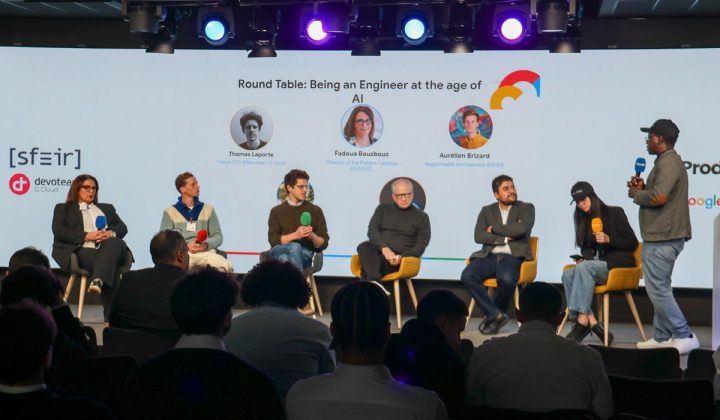
Agentic AI Hackathon Google Cloud : a roundtable
A formative experience for engineering students
This hackathon promoted project-based learning and exposed teams to an advanced technological environment.
It offered a concrete vision of agentic applications in industry, consistent with the issues addressed in the ESILV engineering programme.
The ESILV team’s participation in the GCPU Agentic AI Hackathon highlights the diversity of possible applications for AI agents and the ability of students to design solutions aligned with current societal issues.
More information about ESILV’s Data & Artificial Intelligence specialisation