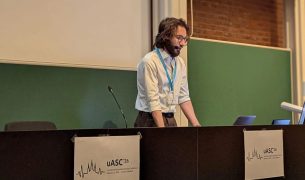

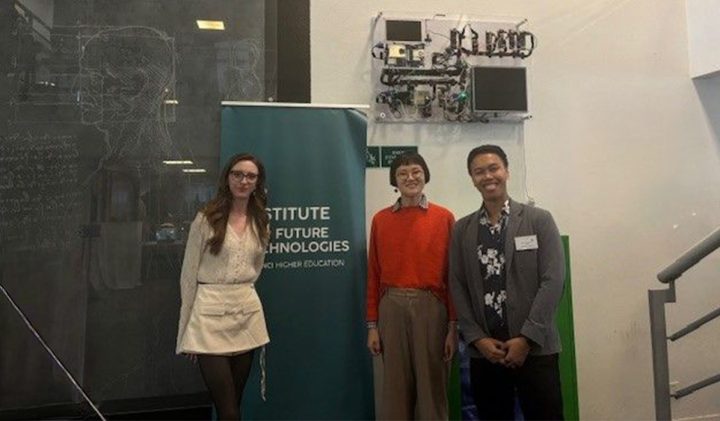
ESILV and the Institute for Future Technologies hosted Irmandy Wicaksono, MIT Media Lab alum and Assistant Professor at the National University of Singapore, for a talk and academic visit dedicated to soft technologies and computational textiles.
Within this context, the presentation focused on how soft materials and digital fabrication are reshaping interactions between technology, the body, and the environment.
A visit at the crossroads of engineering, design, and materials
As part of its research and teaching initiatives, ESILV and the Institute for Future Technologies welcomed Irmandy Wicaksono for an in-depth presentation of his work and ongoing research directions.
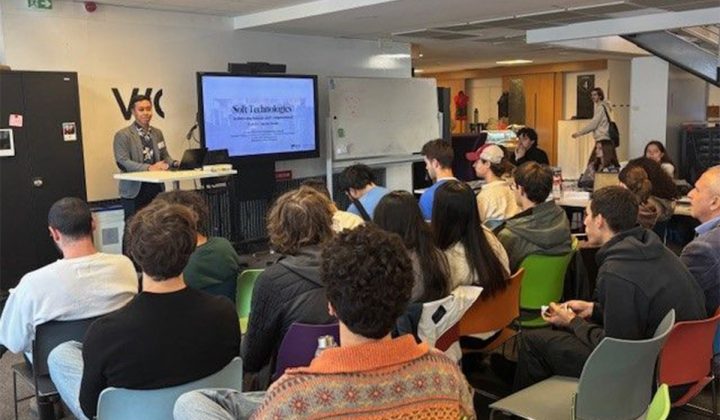
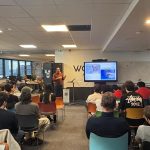
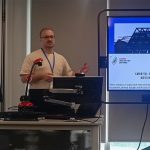
Irmandy Wicaksono during the conference at IFT & ESILV
Currently Assistant Professor (Presidential Young Professor) at the Division of Industrial Design, College of Design and Engineering at NUS, he directs the Soft Technologies Lab, a research group focused on intelligent textiles and soft systems.
The visit provided an opportunity to engage with transdisciplinary approaches that connect electronic engineering, material science, digital fabrication, and design research.
Through examples drawn from academic research and applied projects, the discussion highlighted how textiles can become active interfaces between the body, technology, and the environment.
The Soft Technologies Lab: a transdisciplinary research framework
Based at the National University of Singapore, the Soft Technologies Lab adopts a transdisciplinary methodology to design and develop intelligent textiles and soft systems across scales.
Its research spans wearable objects, interactive environments, and architectural applications, with use cases ranging from health and well-being to human–computer interaction, interactive arts, and built environments.
The lab focuses on the development of fabrication techniques, hardware systems, and algorithmic methods adapted to soft and flexible materials. By combining functional fibers, microelectronics, and digital manufacturing processes, its work aims to advance soft computing technologies while addressing challenges related to scalability, durability, and integration into everyday contexts.
Architecting sensate and computational fabrics
During his talk, titled Soft Technologies: Architecting Sensate and Computational Fabrics Across Scales, Irmandy Wicaksono presented research exploring textiles as technological substrates.
Textiles, among the oldest cultural artifacts, function simultaneously as protection, interface, and medium of expression. Their structural flexibility and proximity to the human body make them particularly suited for emerging applications in ubiquitous computing and personalized health technologies.
The presentation detailed methods using functional fibers and digital machine knitting to control yarn inputs and textile patterns. This approach allows the tuning of electrical and mechanical properties while maintaining formal and aesthetic qualities.
Such techniques enable the creation of sensate textile interfaces based on capacitive and piezoresistive sensing, applied to musical expression, activity recognition, tactile interaction, and large-scale installations including carpets and architectural facades.
From application-specific textiles to programmable fabrics
A key focus of the talk addressed scalability in dense sensate textiles. Research conducted at the Soft Technologies Lab explores flexible and soft printed circuit technologies, as well as distributed, multi-modal sensing systems embedded directly into fabrics.
These developments contribute to new paradigms in power distribution, interconnection, and networking, supporting a transition from single-purpose textiles to programmable computational fabrics.
This vision extends toward what Irmandy Wicaksono describes as an ecosystem of Soft Technologies, where intelligence is integrated seamlessly into the fabric of everyday life, from garments and footwear to interior spaces and architectural structures.
An academic and international research trajectory
Irmandy Wicaksono earned his B.Eng. in Electronic Engineering from the University of Southampton, followed by an M.Sc. from ETH Zurich in Electrical Engineering and Information Technology.

Irmandy Wicaksono
He completed his S.M. and Ph.D. in Media Arts and Sciences at the MIT Media Lab, within the Responsive Environments Group. His background also includes collaborations with industrial and creative partners across fashion technology, consumer electronics, and advanced manufacturing.
Research perspectives for engineering education
This visit aligns with ESILV’s emphasis on interdisciplinary engineering education, integrating digital technologies, material innovation, and applied research.
The exchange offered students and faculty insights into how engineering, design, and research intersect in emerging fields such as smart textiles and soft systems.