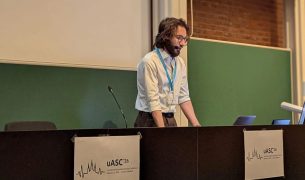

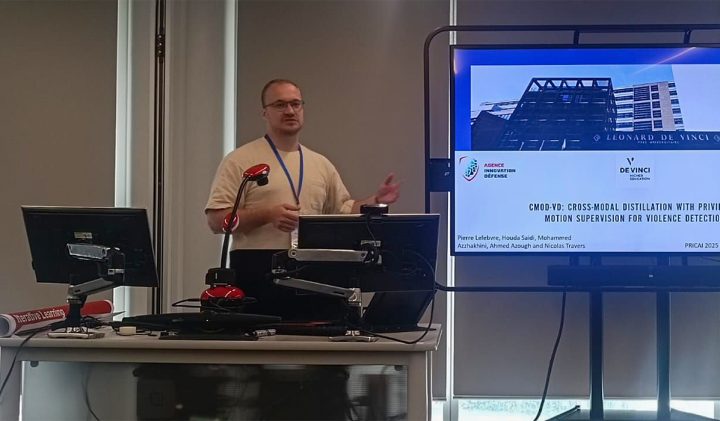
At PRICAI 2025, research carried out within ESILV and the De Vinci Research Center was represented by Pierre Lefebvre, PhD student, who presented recent work on efficient video violence detection.
The contribution addresses key challenges in computer vision related to performance, computational cost, and real-world deployment.
ESILV research represented at an international AI conference
The Pacific Rim International Conference on Artificial Intelligence (PRICAI) is an international scientific event dedicated to artificial intelligence theories, technologies, and applications with social and economic impact across the Pacific Rim. Founded in 1990, the conference has been held annually since 2019 and brings together researchers, practitioners, and academics working across a wide range of AI domains.
During the 2025 edition, ESILV research activities were represented by Pierre Lefebvre, PhD student at the De Vinci Research Center.
On behalf of ESILV, he presented a research paper focused on automatic violence detection in videos, a topic increasingly relevant with the widespread use of surveillance systems and the growing volume of online video content.
Addressing the limits of motion-based video analysis
Automatic violence detection relies on the ability of models to capture complex spatiotemporal patterns. Many recent approaches combine convolutional neural networks with temporal modeling techniques, such as 3D convolutions or recurrent architectures. To improve motion understanding, additional modalities like optical flow are often integrated.
Optical flow has proven effective for modeling motion patterns associated with violent events. However, its estimation remains computationally intensive, which limits its use in real-time or embedded systems. This constraint motivated the research presented at PRICAI 2025.
CMoD-VD: cross-modal distillation with privileged motion supervision
The paper presented by Pierre Lefebvre, titled “CMoD-VD: Cross-Modal Distillation with Privileged Motion Supervision for Violence Detection,” introduces a new approach designed to balance accuracy and efficiency. The proposed method relies on cross-modal distillation to transfer motion knowledge from optical flow during training, while removing the need for optical flow at inference.
The framework is based on two CNN and BiLSTM models enhanced with spatial, channel, and temporal attention mechanisms. A teacher model is first trained using both RGB frames and optical flow videos.
A student model then learns to replicate the teacher’s behavior using RGB data only. As a result, motion information is implicitly encoded without requiring explicit motion computation at runtime.
Experimental results and computational efficiency
Experiments were conducted on several public datasets commonly used for violence detection, including AWF-2000, Hockey Fight, and Violent-Flows. Results show that the student model achieves performance levels close to the teacher model and comparable to state-of-the-art approaches. At the same time, it significantly reduces computational costs, making it more suitable for real-world applications where resources are constrained.
This work was co-authored by Houda Saïdi, Mohammed Azzakhini, Ahmed Azough, and Nicolas Travers. It also received co-funding from the Defence Innovation Agency.
Academic supervision and methodological feedback were provided by Christophe Guilmart. Pierre Lefebvre’s participation in PRICAI 2025 was supported by a student scholarship awarded by the conference committee.
Another doctoral contribution from the De Vinci Research Center
PRICAI 2025 also featured a presentation by Geoffroy Heurtel, PhD student at the De Vinci Research Center. As part of his doctoral research, he presented a paper at both PRICAI 2025 and IVCNZ 2025, hosted by Victoria University of Wellington. His work contributes to advances in artificial intelligence and computer vision applied to industrial contexts.
While in New Zealand, this research activity extended to an industrial setting. Geoffroy Heurtel oversaw the installation of Konatic Spin Reader systems, Datamatrix code readers designed for glass bottles, in a local glass manufacturing plant.
This field deployment illustrates the link between academic research and operational industrial applications.
Research aligned with engineering and AI training
The presence of ESILV-linked doctoral research at PRICAI 2025 reflects the school’s engagement with international research networks in artificial intelligence and computer vision.
Topics such as efficient video analysis, cross-modal learning, and industrial AI systems are closely connected to the engineering curriculum and research activities developed within the De Vinci Research Center.