
Extended Reality (XR), immersive technologies, and interactive media are no longer experimental niches confined to research labs or gaming studios. They have become integral to how stories are told, products are launched, and environments are designed. From virtual production studios to innovation labs, immersive technology is reshaping industries at speed.
For prospective students considering a degree in creative technology, the most pressing question is often a practical one: where do graduates actually work? The answer reveals a field defined not by a single destination, but by convergence.
Beyond Gaming: The Expanding Landscape
While gaming remains one of the most visible entry points into XR, it represents only part of a much wider ecosystem. Creative technology graduates increasingly operate in sectors that value immersive thinking as much as technical execution.
Entertainment companies continue to recruit real-time 3D artists, XR developers, and interactive narrative designers. However, the rise of virtual production has expanded opportunities far beyond traditional game studios. Film and television now rely heavily on real-time engines such as Unreal and Unity, LED volume stages, and motion capture systems. Graduates trained in spatial design and real-time workflows contribute to the creation of virtual sets, digital environments, and hybrid physical–digital productions.
The boundaries between cinema, animation, and game development are dissolving. In this convergence, creative technologists occupy a crucial position: they understand both the artistic language of storytelling and the technical infrastructure that enables immersive worlds.
Brand Experience and Experiential Design
Immersive technology has also transformed how brands communicate. Consumers increasingly expect interaction rather than passive viewing. As a result, creative agencies and innovation teams are developing augmented reality campaigns, virtual showrooms, and interactive installations that enable audiences to engage directly with products and narratives.
Graduates in immersive media often join digital agencies or in-house innovation labs as creative technologists or experience designers. Their work may involve prototyping AR filters, designing interactive retail environments or developing immersive event installations. What distinguishes them in these settings is their ability to translate conceptual ideas into functional systems, bridging design, coding and user experience.
Luxury, fashion, and cultural brands, in particular, have embraced immersive storytelling as a means of extending identity into the digital space. Virtual fashion, spatial commerce and interactive exhibitions have created roles that did not exist a decade ago.
Simulation, Industry and Applied XR
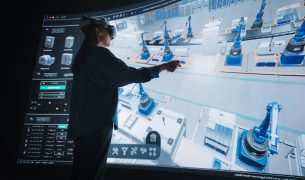
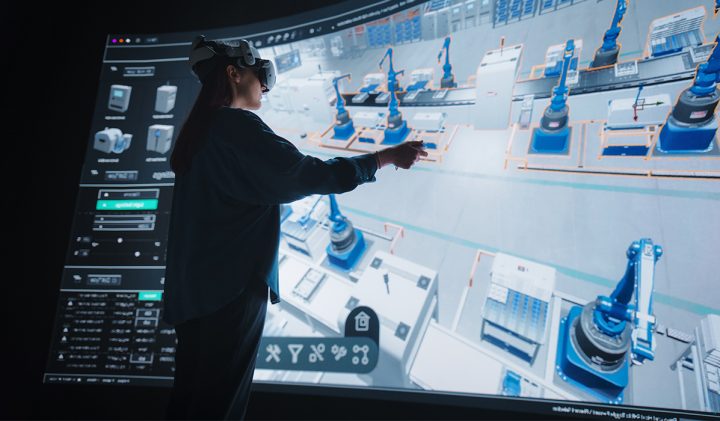
Outside the creative industries, immersive technology is becoming an essential tool in simulation and professional training. Engineering firms use digital twins and 3D environments to test systems prior to construction. Medical institutions develop VR simulations for surgical training and therapeutic applications. Architects and urban planners rely on immersive visualisation to communicate complex spatial proposals.
Creative technology graduates working in these environments apply their design thinking to highly technical contexts. Their role is not merely to build accurate models, but to ensure that simulations are intuitive, interactive and human-centred. The success of a training environment often depends on experience design as much as on engineering precision.
This shift illustrates a broader truth: immersive skills are transferable. Spatial design, interaction logic and real-time prototyping are as valuable in healthcare and infrastructure as they are in entertainment.
Cultural Institutions and Public Engagement
Museums, galleries and heritage institutions are also undergoing digital transformation. Immersive installations, augmented exhibition layers and interactive storytelling rooms are becoming part of contemporary audience engagement strategies.
In these contexts, creative technology graduates operate at the intersection of narrative, design and interpretation. They design systems that allow visitors to experience history, art or science in embodied and participatory ways. Rather than simply displaying information, immersive environments invite exploration.
The ability to transform abstract content into spatial experiences is increasingly sought after in public and cultural sectors, particularly as institutions compete for digitally literate audiences.
Entrepreneurial and Hybrid Pathways
The interdisciplinary nature of creative technology education often encourages entrepreneurial thinking. Many graduates do not follow a traditional employment path; instead, they establish independent studios or collaborative collectives. Small XR production companies, immersive installation studios and interactive design consultancies frequently emerge from graduate networks.
The field rewards adaptability. Because immersive technology evolves rapidly, those who can prototype quickly and respond to emerging tools are particularly well positioned to launch innovative ventures.
The integration of artificial intelligence, spatial computing and real-time rendering continues to open new commercial and creative opportunities.
The Rise of Spatial Computing
As major technology companies invest in spatial computing platforms and mixed-reality hardware, demand for professionals with expertise in three-dimensional interfaces is increasing. The screen is no longer the sole interface; interaction is becoming spatial, embodied and contextual.
Graduates trained in immersive media are well placed to contribute to this transition. Their expertise in interaction design, human–computer interfaces and real-time development equips them to design experiences for emerging platforms. Roles such as spatial UX designer or immersive product developer reflect this ongoing transformation.
Importantly, employers are not seeking technical ability in isolation. They value individuals who can combine programming knowledge with creative direction, critical thinking and collaborative practice. The most successful graduates are those who can move fluently between artistic experimentation and structured production workflows.
A Field Defined by Convergence
XR, immersive technology and interactive media do not belong to a single industry. They represent a convergence of art, computing, storytelling and engineering. This convergence explains why career outcomes appear so diverse. A graduate might begin in gaming, transition into virtual production, and later apply immersive design principles within architecture or healthcare.
The career pathways explored in this article align closely with the objectives of the ESILV Master’s Degree in Engineering- PGE with a major in Creative Technology.
This specialisation is designed to train students for roles as Creative Technologists—professionals capable of inventing new products and innovative applications of cutting-edge technologies, including immersive and mixed-reality systems, within transdisciplinary environments.
The programme equips graduates with a blend of technical, creative and strategic skills, from real-time media and artificial intelligence to user-centred design and disruptive innovation, precisely the competencies that today’s employers seek in sectors such as immersive entertainment, interactive media, brand experience and spatial computing.
Through project-based learning that bridges research, design, and production, students emerge prepared not only to enter these dynamic fields but also to shape them—turning imaginative concepts into functional, market-ready experiences.
What remains constant is the growing demand for individuals capable of designing meaningful digital experiences. Creative technology graduates are not simply adapting to this future. They are actively constructing it.