
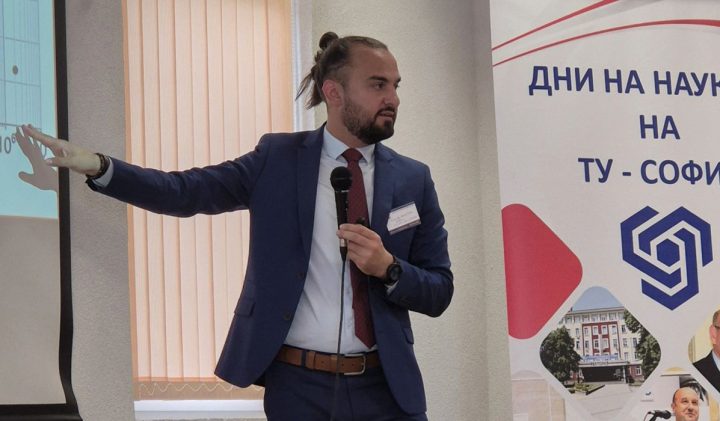
At the BulTrans 2025 conference in Sozopol, Bulgaria, HamidReza Vanaei presented research conducted with Aerospace Track students at ESILV.
The study examines how 3D printing can facilitate aerospace innovation by enabling the structural and vibration analysis of composite fins.
Aerospace research showcased in Bulgaria
HamidReza Vanaei, Associate Professor at ESILV, took part in the 17th edition of BulTrans, the International Scientific Conference on Aeronautics, Automotive and Railway Engineering and Technologies, organised by the Faculty of Transport at the Technical University of Sofia. The event brought together experts and academics to discuss key challenges in transport engineering.
The project, “Structural and Vibration Analysis of 3D-Printed Composite Fins for Aerospace Innovation,” was the outcome of work carried out by ESILV students within the Aerospace Track, under the supervision of their faculty mentor.
It highlights how additive manufacturing can contribute to the development of lighter and more efficient components in the aerospace industry.
BulTrans: a leading scientific forum
BulTrans has been held annually since 2009, mainly in Sozopol. Over the years, it has become the most important scientific meeting for road, rail, and air transport in Bulgaria.
The conference has garnered international recognition, with selected papers published in indexed journals, including Scopus and Web of Science.
Since 2017, BulTrans has developed partnerships with publishers such as EDP Sciences, IOP Publishing, and AIP Publishing, ensuring the international visibility of the research presented. For the 2025 edition, qualified papers will be published in a special issue of Engineering Proceedings, an open-access journal indexed in Scopus.
Topics of the conference
The BulTrans program encompasses a broad range of research areas, including aeronautics and astronautics, as well as automotive and railway engineering. Green transportation, innovative technologies, transport infrastructure, and logistics are also among the core themes.
Aerospace & Defense Major at ESILV
The Aerospace & Defense track at ESILV allows future generalist engineers to develop advanced skills during the final years of the engineering cycle.
The program covers flight and orbital dynamics, combustion and propulsion, as well as the design, connectivity, and automation of aerospace systems.
Students acquire the knowledge needed to understand flight techniques within the atmosphere and in space, simulate multiphysics interactions, study and optimise propulsion systems, and develop flight and orbit control software. The track also integrates advanced digital technologies for the study, design, simulation, validation, and optimisation of both existing and emerging systems.