

Over the past six months ESILV has expanded its network of international academic partners across Europe, Asia, North America and Africa. These agreements open new pathways for student mobility, double degrees and collaborative research.
A growing number of partnerships reflects a consistent international strategy, aligned with the expectations of engineering education in a global context.
International experience: an essential step for students
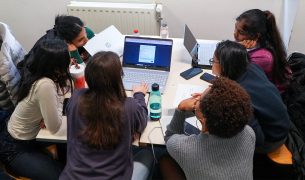
International exposure forms a core component of the engineering curriculum at ESILV. Academic mobility allows students to study in different educational systems, work in multicultural environments and strengthen language skills.
These experiences also contribute to the development of analytical and adaptive capacities. Working on projects abroad or following courses in another country provides a different perspective on engineering practices, innovation ecosystems and industrial challenges.
In parallel, exchanges between faculty members and joint research initiatives support the circulation of knowledge and reinforce academic cooperation.
Strengthening partnerships in Europe
Several agreements signed during this period reinforce ESILV’s presence within the European Higher Education Area.
Politehnica University Timisoara
The partnership with Politehnica University Timisoara in Romania, Erasmus+, focuses on engineering fields such as robotics and industry. It provides semester exchanges for both Bachelor and engineering students, along with academic mobility for faculty.
University of Turku in Finland
In Northern Europe, the agreement with the University of Turku in Finland extends an existing collaboration within De Vinci Higher Education. It allows engineering students to access programmes in computer science, mechanical engineering and materials science in a research-oriented environment.
The University of Southern Denmark
The University of Southern Denmark (SDU) also joins the network. Recognised in international rankings, SDU offers an academic setting structured around research and interaction between students and faculty. This partnership introduces new mobility opportunities in Scandinavia.
University of Birmingham
The addition of the University of Birmingham further expands options in the United Kingdom. Known for its strong research output and international outlook, the institution provides access to high-level academic resources in engineering and applied sciences.
Expansion in Asia and emerging collaborations
Asia remains a strategic region for ESILV’s international development.
Keimyung University
A new agreement with Keimyung University in South Korea strengthens an already established network of Korean partner institutions. This collaboration supports student exchanges and joint research initiatives in engineering and digital technologies.
University of Malaya
The integration of the University of Malaya adds a new destination in Southeast Asia. Although more recent, this collaboration broadens academic exposure to a region characterised by rapid technological and economic development.
These partnerships contribute to a diversified set of mobility destinations, allowing students to engage with different innovation ecosystems.
North America and double degree opportunities
Concordia University
In Canada, the agreement with Concordia University’s Gina Cody School of Engineering and Computer Science includes both semester exchanges and a double-degree pathway.
Located in Montreal, Concordia offers programmes taught in English within a multicultural environment. The partnership targets several engineering majors, including artificial intelligence, cybersecurity, mechanical engineering and sustainable energy.
This development reflects an effort to provide structured academic pathways in North America that combine mobility with degree recognition.
New openings in Africa and the Mediterranean region
SMU Tunisia
The collaboration with SMU Tunisia (South Mediterranean University) extends ESILV’s partnerships in North Africa.
This agreement supports academic exchanges in a region where engineering education is closely linked to economic development and technological transformation. It also facilitates connections between European and African academic environments.
Such partnerships contribute to a broader geographical balance in mobility opportunities.
A diversified and coherent international network
From October 2025 to March 2026, ESILV has consolidated its international positioning through partnerships across multiple continents.
These agreements cover a wide range of academic formats: semester exchanges, Erasmus+ mobility, faculty collaboration and double degrees. They also reflect a diversity of academic cultures and technological specialisations.
For engineering students, this network provides access to varied learning environments, from research-intensive universities to innovation-driven ecosystems.