
Wissal Benjira, PhD graduate at De Vinci Higher Education, presented research on graph-oriented models designed to improve the use of open data for sustainability indicators. Her work connects data science, geomatics and knowledge representation to support the computation of United Nations indicators.
This research contributes to ongoing efforts to structure and interpret open data in ways that support decision-making across multiple territorial scales.
A research topic at the intersection of data and sustainability
Sustainable Development Goals (SDGs), defined by the United Nations, rely on a set of indicators used to measure progress in environmental, social and economic domains. These indicators require data that can be interpreted across different geographical levels, from national to local contexts.
In practice, accessing and processing this data raises several challenges. Open data sources are numerous, yet their formats, structures and semantics vary significantly. This heterogeneity limits their direct use for computing reliable and comparable indicators.
Wissal Benjira’s PhD research addresses this issue through graph-oriented models. Conducted between CNAM, ESILV and Géodata Paris, and co-funded by IGN and De Vinci Research Center, the thesis was directed by Nicolas Travers and focuses on integrating, mapping and querying open data to support sustainability analysis.
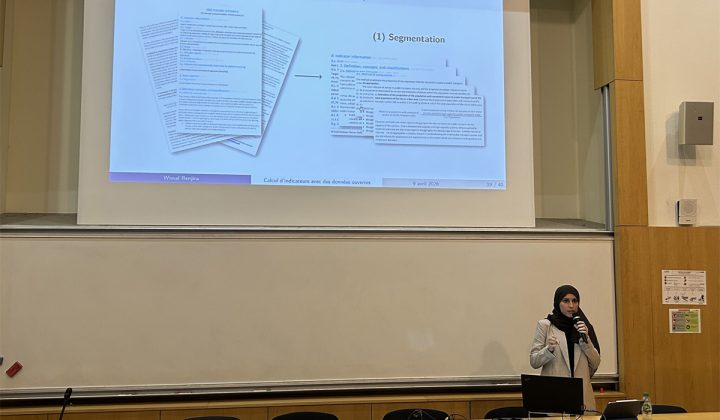
Wissal Benjira, PhD graduate at De Vinci Higher Education, during her presentation
A dual-graph architecture to structure information
The proposed approach relies on a dual-graph architecture. The first component, called the SDG Graph, represents the conceptual structure of sustainability indicators. It models entities, relationships and attributes based on official United Nations documentation.
The second component, the Metadata Graph, describes available open data sources. It captures information about datasets, including their structure, origin and potential use.
The alignment of these two graphs forms a knowledge graph named SDG-KG. This unified structure enables joint reasoning between indicators and data sources. It facilitates queries that identify relevant datasets and supports the computation of indicators using heterogeneous data.
This approach introduces a formal way to translate the definition of an indicator into a model that can be queried. It also improves transparency in how indicators are calculated, which contributes to better interpretability of results.
Bridging geomatics and graph data models
One of the contributions of this research lies in its connection of different scientific domains. The work brings together geomatics, graph data modelling and database systems.
Geospatial data plays a central role in many sustainability indicators. Integrating this data into graph-based models requires specific representations and mappings. The thesis demonstrates how these elements can be combined to support multi-scale analysis.
Nicolas Travers, Deputy Director of DVRC highlights this aspect:
“Wissal succeeded in creating a bridge between geomatics and graph databases, which requires a strong understanding of both domains.”
This interdisciplinary approach expands the range of tools available for working with open data in sustainability contexts.
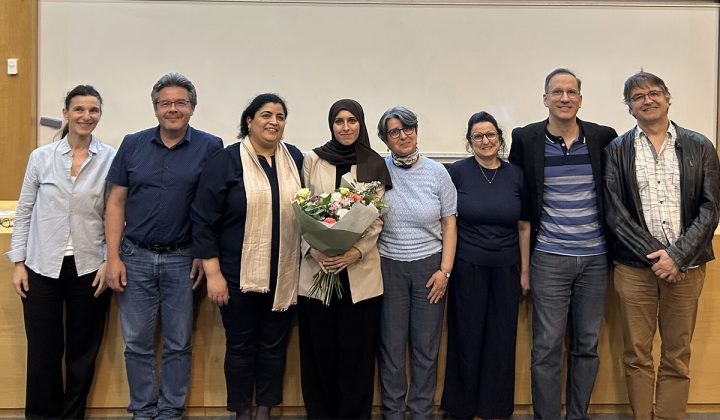
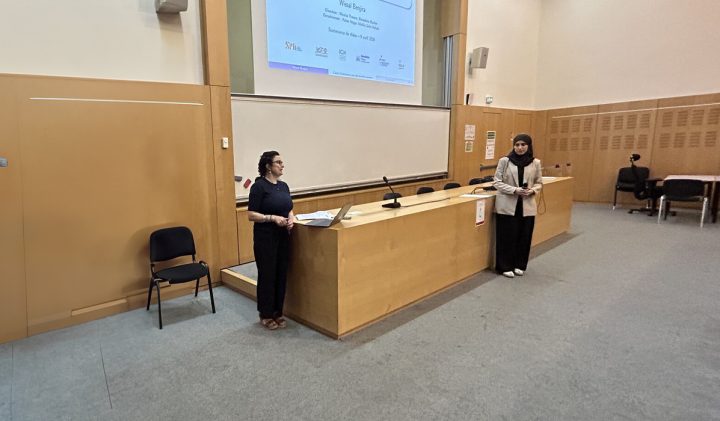
Together with Nicolas Travers, Bernd Amann and Olivier Teste, and the jury member Samira Cherfi.
Scientific contributions and recognition
The research has been presented in several international venues, including VLDB, DKE and IEEE Big Data. These publications reflect the relevance of graph-based approaches in data integration and querying.
In addition, the work received the Best Demo Award at BDA 2025, recognising the practical implementation of the proposed models.
The thesis also introduces perspectives for future developments. One direction involves connecting data providers and users more effectively. By structuring both data and questions within a shared framework, the model supports interactions between those who produce datasets and those who seek to analyse them.
Towards more reliable use of open data
Open data represents a significant resource for analysing sustainability issues. Its effective use depends on the ability to structure, interpret and connect datasets across domains.
Graph-oriented models provide a framework to address these challenges. By combining semantic representation and data integration, they support more consistent and transparent computation of indicators.
This research, conducted at ESILV and its partner institutions, contributes to advancing methods for data-driven sustainability analysis.